
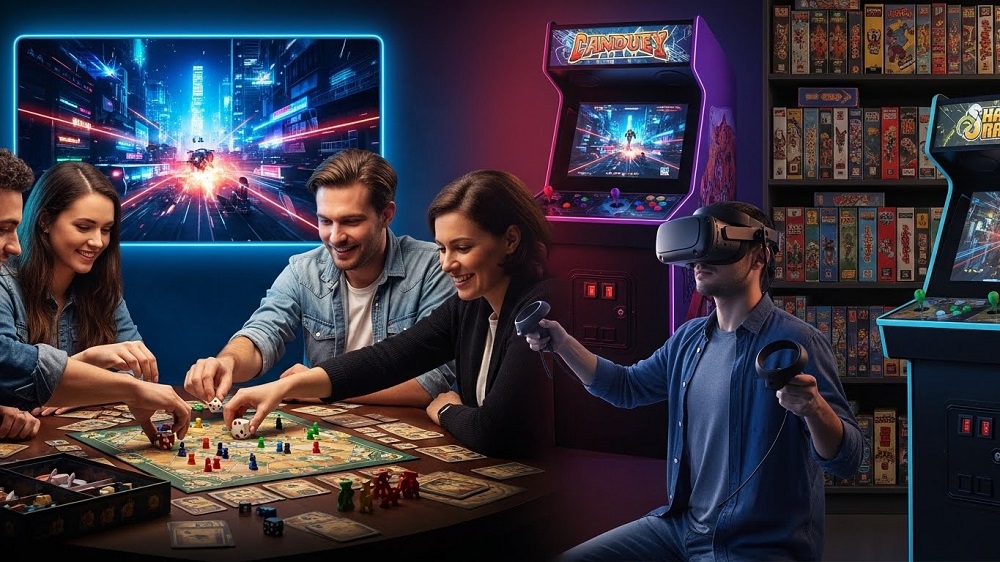

For decades, video games were viewed primarily as a niche hobby confined to arcade halls and suburban basements. The stereotypical image of a gamer was a solitary teenager navigating pixelated landscapes. Today, that perception is entirely obsolete. Gaming has evolved into the most dominant, lucrative, and culturally influential sector of the global entertainment industry.
The reach of interactive media extends far beyond the boundaries of traditional entertainment. Video game design principles, virtual economies, and immersive technologies are actively restructuring how humans socialize, work, learn, and manage their health. Gaming is no longer just a passive escape; it has become a fundamental lens through which we interact with the physical and digital world.
The Cultural Shift in Mass Entertainment
To understand how games are altering everyday life, one must first look at how they have disrupted traditional media. For generations, Hollywood films, television broadcasts, and the music industry held a monopoly on human attention. That hierarchy has permanently flipped. The global gaming market regularly outpaces the combined revenue of the film and music industries, driven by a global community of billions of players across PCs, home consoles, and mobile devices.
The fundamental shift lies in the nature of engagement. Traditional media offers a linear, passive experience. A viewer watches a story unfold exactly as the director intended. Video games, by contrast, offer agency. Players are not merely spectators; they are active participants whose choices, reflexes, and strategies shape the outcome of the narrative. This interactive agency creates a profound sense of psychological ownership and emotional investment that standard media cannot match.
Redefining Narrative Art and Cinema
The boundary between filmmaking and game development has largely collapsed. Modern video games feature Hollywood-caliber writing, orchestral scores, and sophisticated motion-capture performances by award-winning actors. Titles like The Last of Us, Red Dead Redemption, and Alan Wake are celebrated not just for their mechanics, but for their literary depth, complex character arcs, and mature explorations of morality, grief, and identity.
This creative exchange is a two-way street. Traditional entertainment now relies heavily on gaming technology. Unreal Engine, a real-time 3D creation tool built by Epic Games for video game development, is now standard infrastructure in Hollywood production. Television shows and films use this software to render massive, photorealistic digital backdrops on giant LED screens, allowing actors to interact with complex virtual environments in real time on set. The mechanics of gaming have quite literally rewritten the rules of filmmaking.
Virtual Spaces as the Modern Social Commons
The playground and the local community hub have migrated into virtual worlds. For younger generations, online multi-player ecosystems function as digital third places—spaces outside of home and school where people gather to talk, build relationships, and share experiences. Games like Fortnite, Roblox, and Minecraft have evolved past their original design parameters into massive social networks.
Within these spaces, traditional gameplay often takes a backseat to casual socialization. Friends log in not to compete, but simply to hang out, customize their digital avatars, and catch up on their day. This shift has transformed games into premier venues for live cultural events. Millions of people routinely gather inside virtual arenas to watch live-streamed concerts by global musical artists, view exclusive film trailers, and purchase digital fashion items from real-world luxury brands. The line between physical identity and digital presence has permanently blurred.
Gamification: Rewiring Productivity and Motivation
Perhaps the most pervasive way gaming shapes everyday life is through gamification—the practice of integrating game mechanics like point scoring, badges, leaderboards, and leveling systems into non-gaming contexts. By tapping into human desires for competition, achievement, and structural progression, organizations are transforming previously tedious tasks into engaging challenges.
Workplace Dynamics and Corporate Training
Modern businesses utilize gamification to optimize employee training, improve workplace safety, and boost productivity. Instead of reading dense compliance manuals, employees participate in interactive simulations where they earn points and rank up by successfully navigating realistic workplace scenarios. Sales teams utilize real-time leaderboards to foster friendly internal competition, while customer service platforms reward representatives with digital badges for resolving user issues quickly and efficiently.
Education and Personalized Learning
The traditional educational framework of lectures and standardized tests is increasingly being augmented by game-based learning models. Educational platforms use leveling mechanics to help students master new languages, mathematics, and coding. Rather than punishing failure with a poor grade, these platforms treat mistakes as a standard part of the learning curve, encouraging students to repeat a challenge until they unlock the next skill tier. This shifts the psychological mindset of education from fear of failure to an active desire for mastery.
The Therapeutic and Cognitive Power of Gaming
For years, public discourse was dominated by concerns over the potential negative impacts of screen time. However, rigorous contemporary psychological and neurological research has revealed that structured gaming offers substantial cognitive, emotional, and physical benefits.
-
Cognitive Enhancement: Action-oriented video games require intense visual attention, rapid spatial processing, and split-second decision-making. Studies show that regular players often display superior spatial awareness, enhanced working memory, and advanced problem-solving capabilities compared to non-gamers.
-
Medical Rehabilitation: Virtual reality systems and motion-controlled games are standard tools in physical therapy clinics. Stroke patients and individuals recovering from severe physical trauma utilize interactive games to rebuild motor skills, balance, and spatial coordination through engaging, repetitive physical challenges.
-
Mental Health and Pain Management: Doctors use specialized video games to help patients manage chronic pain and treat psychological conditions like post-traumatic stress disorder. By immersing a patient in a highly engaging virtual environment, the brain is flooded with sensory data, effectively distracting it from processing pain signals or anxiety triggers.
Economic Transformation and the Rise of Digital Careers
The financial landscape of gaming has democratized wealth creation, turning a casual hobby into a viable career path for millions of creators worldwide. The rise of streaming platforms like Twitch and YouTube Gaming has birthed a massive ecosystem of content creators, esports athletes, and digital commentators who command audiences larger than many traditional cable television networks.
Simultaneously, the concept of digital ownership has shifted. Virtual economies within games feature complex structures where players buy, sell, and trade digital commodities using real-world currency. For many individuals, creating digital assets—such as virtual clothing designs, custom game modes, or architectural spaces within platform ecosystems—has become a full-time, lucrative profession. The definition of what constitutes a job is being actively rewritten by the digital real estate of the gaming world.
A Permanent Evolution
Video games have outgrown their original definition as entertainment software. They have matured into a foundational pillar of modern civilization, serving as a catalyst for technological innovation, a canvas for profound artistic expression, and a structural framework for modern societal interactions. As virtual reality, artificial intelligence, and cloud computing continue to advance, the integration of gaming into our daily routines will only deepen. We are no longer transitioning into a digital age; we are living in a gamified world where the mechanics of play are shaping the reality of human progress.
Frequently Asked Questions
What exactly is the difference between gamification and game-based learning?
Gamification is the practice of applying specific game elements, such as point systems, badges, and progress bars, to everyday activities or tasks to increase user engagement. Game-based learning involves using actual video games with defined educational goals to teach a specific subject matter or skill, allowing users to learn through the active playing of the game itself.
How has the corporate world adopted gaming technology beyond standard training?
Beyond training, corporations use video game technology for architectural design, product prototyping, and data visualization. For instance, automotive companies utilize real-time game engines to design cars in 3D environments, test aerodynamic simulations virtually, and allow customers to interact with digital models of vehicles before they enter physical manufacturing.
Can video games actually help slow down age-related cognitive decline?
Research indicates that certain types of video games, particularly those that emphasize strategy, spatial puzzle-solving, and memory management, can help maintain cognitive flexibility in older adults. These games challenge the brain to process new information dynamically, which can help reinforce neural pathways and improve everyday executive functions.
How do virtual economies within video games impact the real-world economy?
Virtual economies interact with the real world through the monetization of digital goods, services, and labor. Players spend actual currency to acquire virtual assets, and top-tier digital creators earn regular livelihoods by designing and selling items in virtual marketplaces. Additionally, major international corporations invest heavily in digital marketing, virtual storefronts, and intellectual property licensing within game spaces.
What role does artificial intelligence play in modern game development?
Artificial intelligence is used to generate dynamic behaviors in non-player characters, automatically generate massive, unique open-world landscapes, and optimize graphics rendering. AI also monitors player behavior in real time to adjust game difficulty dynamically, ensuring the experience remains engaging without becoming overly frustrating or too easy.
Why are video games considered more effective for socializing than traditional social networks?
Traditional social networks are primarily text, image, or video-based feeds, which can lead to passive scrolling. Video games provide shared, active spaces where individuals must collaborate, communicate, and solve problems together to achieve a goal. This shared experience creates stronger social bonds and mimics the natural, unstructured socializing that occurs in physical environments.

Comments are closed.